1580 Geneva Bible Quarto (Original Leather Boards & Metalwork) | Sold for $4,500 | (Herbert 165)
Updated: Sep 1
This well preserved 1580 Bible is the definitive textbook of the Protestant Reformation and the primary literary backdrop of the Elizabethan era. First translated in 1560 by English exiles fleeing religious persecution, the Geneva Bible bypassed crown control to become the preferred translation of William Shakespeare, John Bunyan, and the Mayflower Pilgrims. By utilizing an accessible, affordable quarto format and clear Roman typeface rather than archaic Gothic script, this edition revolutionized early modern literacy. It shifted theological study away from the public church pulpit and directly into the private, domestic sphere of the English home.
Sold for $4,500 | ← Return to Past Sales | Active Sales Page →
T H E B I B L E .
Translated according to the Ebrew and Greeke, and conferred with the best translations in divers languages. With most
profitable Annotations upon all the hard places, and other things
of great importance, as may appeare in the Epistle to the Reader.
And also a most profitable Concordance for the readie finding out of any thing in the
same conteined.
Ioshua. 1. 8.
Let not this booke of the Law depart out of thy mouth, but meditate therein day and night, that thou mayest observe and doe according to all that is written therein: for then shalt thou make thy way pros- perous, and then shalt thou have good successe.
Imprinted at London by Chri-
stopher Barker, Printer to the
Queenes most excellent
Maiestie.
1 5 8 1
Cum gratia & privilegio Regiæ Maiestatis.
About this Particular Bible
This edition introduced mechanical verse divisions, cross-references, and a comprehensive concordance. It known for being the world’s first "study Bible," However, its most radical feature is the extensive marginal commentary written by Calvinist scholars. The annotations within this Bible advocated for a believer's direct accountability to God, famously implying that citizens could disobey tyrannical rulers, a political philosophy that so angered the monarchy that King James I attempted to phase it out by commissioning the King James Bible of 1611 specifically to banish these marginal notes. Survival of the volume's original Tudor leather and metal furniture makes it an extraordinarily rare artifact of printing history.
The Exterior
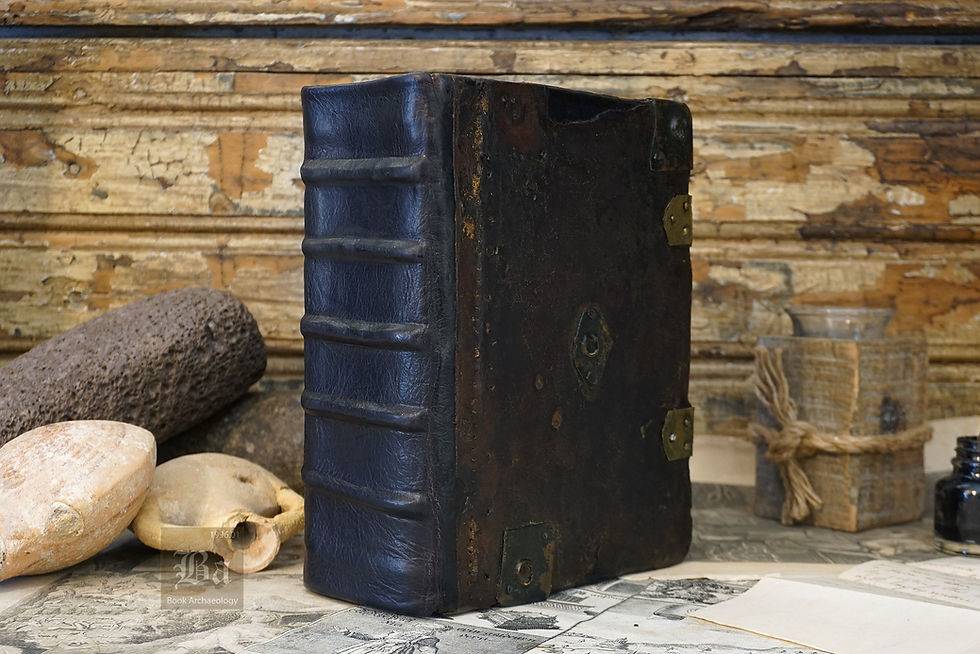
This exceptionally rare, surviving 1580 Geneva Bible Quarto rests in its original, contemporary late 16th-century Tudor binding, offering a magnificent material testament to Elizabethan Bible production. Bound in deep, dark-tanned calfskin leather over heavy, robust wooden boards, the volume boasts an authentic, untouched surface patina defined by natural craquelure, historic scoring, and centuries of handling. The binding is fortified with original brass furniture, a hallmark of high-status protective craftsmanship from the era. The scalloped brass corner pieces with central domed rivets, shield the outer edges from wear, while two heavy fore-edge brass catch plates remain securely anchored to the boards. In the 16th century, these clasps played a vital functional role; by keeping the rag-paper text block under constant compression, they barred destructive dust and prevented the pages from warping or "cockling" due to fluctuating environmental humidity. As a physical artifact, this binding reflects a period when the vernacular Bible was treated not just as text, but as a heavily armored family treasure built to endure generations of daily devotional use.
The Interior
A^3 Preliminaries,
A-Z^8, Aa-Zz^8, Aaa-Yyy^8 Zzz^10 - Containing The Bible Scripture (Complete),
(A-K^8 L^2) Two Right Profitable and Fruitfull Concordances (Complete),
(A-F^8 G^6) Contains a Complete Booke of Psalmes, Collected in English Meter and an Incomplete Forme of Prayers to be used in Private Houses. This volume consists of three distinct parts.
Interpretation:
This book is printed in "quarto" format, meaning each sheet of paper was folded twice to create groups of 4 leaves (8 pages). Printers marked these groups with letters called "signatures" to keep them in order.The Preliminaries (Introductory Pages): The book begins with signature A. It has 3 leaves (6 pages) containing the title page and introductory material. The Main Bible Text: The Old Testament, Apocrypha, and New Testament run continuously. They use three full runs of the alphabet: First alphabet: A to Z (8 leaves each). Second alphabet: Aa to Zz (8 leaves each). Third alphabet: Aaa to Yyy (8 leaves each). Final section: Zzz has 10 leaves (20 pages) to finish the main text. This complete Bible text is fully intact. The Concordances: A separate section follows, marked with a new set of signatures from A to K (8 leaves each) and ending on L with 2 leaves (4 pages). This index is complete.The Book of Psalms & Prayers: The final section contains the Psalms in meter and private prayers. It uses another alphabet run from A to F (8 leaves each), followed by G with 6 leaves. This portion is mostly complete but has a missing section at the very end.
Detailed Report:
This Bible has what appears to be newer pastedowns that have been aged along with two aged fly-leaves the are followed by two original fly-leaves. The first original fly-leaf has some writing, pointing out some chapters and verses as well as indicating a date of 1580 and a Herbert Catalog Number of 165. This is followed by two original Fly Leaves, that lead the General Title Page incorrectly dated as 1581 (Actual Date is 1580). This is followed by one preliminary leaf, On the Recto is "To The Christian Reader" and on the Verso is "How to take profite in reading of the holy Scriptures". This is followed by the first page of Genesis (A1). B4-B5 (Genesis) have a small burn mark slightly effecting text. E2-E3 (Exodus) has minor stain effecting a few words of text without loss, E3 also has a small ink stain effecting one word of scripture. F3-F7 has moderate to severe damp stainging, not effecting legibility of text. J3 has small chip, with a closed tear at the lower margin, effecting one word of text on recto and verso. O2 (Ruth) has moderate damp stainging along the fore-edge of the leaf, mostly visible on recto. O7-O8 has light dampstaining along the upper margin and lower margin. o8 has a small inscription of a enclosed date of 1663. Cc4 has minor ink stain effecting slightly effecting text, on a few words of scripture. Dd3 has a small ink smudge on the outer margin of the verso, not effecting text. Dd5 has a small closed tear at the lower margin, without loss. Gg1 has tiny closed tear at outer margin, slightly effecting text without loss. Jj1 has a small chip at the upper margin, effecting one word of text on the recto and verso. Jj2 has tiny closed tear effecting marginal notes, without loss. Jj8 ahs a tiny hole slightly effecting marginal notes. Kk6 has a small chip at the lower margin, effecting one word of marginal notes. Ll1-Ll2 has moderate damp stain along outer margin. Ll8-Mm1 has ink smudging effecting text, but reamins legible. Nn6 has a small burn hole, effecting a couple words of scripture on the recto and verso. Nn7 has a small burn mark, risidual from previous leaf, effecting one word of text on the recto. Pp3-Pp4 ahs light ink smudging, text remains quite legible. Ss4-Tt3 has moderate damp stain along the outer margin, text remaining quite legible. Tt7-Uu3 has damp stain along outer margin, text remains quite legible.Uu7-Uu8 has damp stain along outer margin. Vv2 has an ink stain effecting a few words of text but still legible. Yy6 has a page repair at the fore-edge of the recto, nicely done and text remains legible.
(Incorrect Original Title Stating 1581)
Sold for $4,500 | ← Return to Past Sales | Active Sales Page →


