1613 King James Bible - (Second Edition) | $9,950 | (Herbert 322.)
Updated: Aug 27
The 1613 King James Bible "true" Second Folio Edition contains a complete section of the Apocrypha. The Apocrypha was an essential, mandatory component of all official Church of England pulpits in 1613. In early King James Bibles, the Apocrypha served as a major theological battleground between the crown and religious dissidents. The Scripture is arranged in two columns per page, with exactly 72 lines of small Gothic "black letter" font. This unique & elegant layout was condensed by royal printer Robert Barker to fit more lines per page than his famous 59-line 1611 first edition. It stands out because it systematically corrects approximately 400 printing errors found in the original 1611 translation. This specific printing became famous and highly notable as a strategic, less expensive alternative for churches requiring a large pulpit Bible, condensed skillfully into the only large folio edition to ever use this 72-line layout. Herbert 322 | ESTC S122066 | Large Folio Bible (15 1/2 x 11 1/2 in | 39.4 x 29.2).
Price $9,950 | Purchase Page | See all SKU: 92008 (E)

About this Particular Bible
The 1613 King James Bible Edition stands out because it represents a desperate political and religious compromise following the explosive collapse of the Tudor Dynasty and the rocky ascension of the House of Stuart under King James I. Inheriting a highly fractured England, James faced intense pressure from the Puritans, who championed the popular Geneva Bible and vehemently opposed the inclusion of the Apocrypha. James, however, despised the Geneva Bible text, because of its marginal notes, which suggested ordinary subjects could justly resist tyrannical monarchs. To assert absolute royal supremacy and suppress Puritan dissent, James commissioned this uniform translation, explicitly banning all opinionated study notes and enforcing rigid ecclesiastical hierarchy. This specific 1613 printing became famous and highly notable as the crown’s definitive weapon for religious conformity, forcing a unified liturgy onto every church pulpit across England. Robert Barker was solely responsible for the massive financial costs of production, including labor, ink, and expensive paper. The decision to switch to a 72-line format was a strategic move by Robert Barker. By using a smaller black-letter font and increasing the line count from 59 to 72, Barker significantly reduced the amount of paper needed. This cut the total page count from approximately 732 leaves down to 508, lowering his overhead. Barker was financially strained by the high costs of the initial 1611 printing and used the 1613 edition as a more economical way to continue fulfilling the demand for Bibles. However, due to the fact that the folio Bibles were primarily used to be read from a pulpit, the format returned to the original 59-line standard for the next 4 editions, making this an incredibly rare, one year only printing. While the exact number of copies for the 1613 72-line folio (Herbert 322) was not recorded, historians estimate the print runs for early King James folios typically ranged between 1,500 and 2,000 copies per edition. But because these were large pulpit Bibles intended for heavy daily use, many copies were literally "worn out," making complete examples extremely rare today.
Historic Aura / Vibe: To hold or behold this Bible is to step into the world of Shakespeare, Thomas Lodge, and the literary titans of the English Renaissance. It provides a living bond to the Reformation, an epoch that birthed modern theology and forged the 'majestic cadence' of English scripture. This text stands as an enduring witness to the Textus Receptus, the venerable manuscript tradition that served as the spiritual bedrock for the generations who built the modern English tongue.
The Exterior
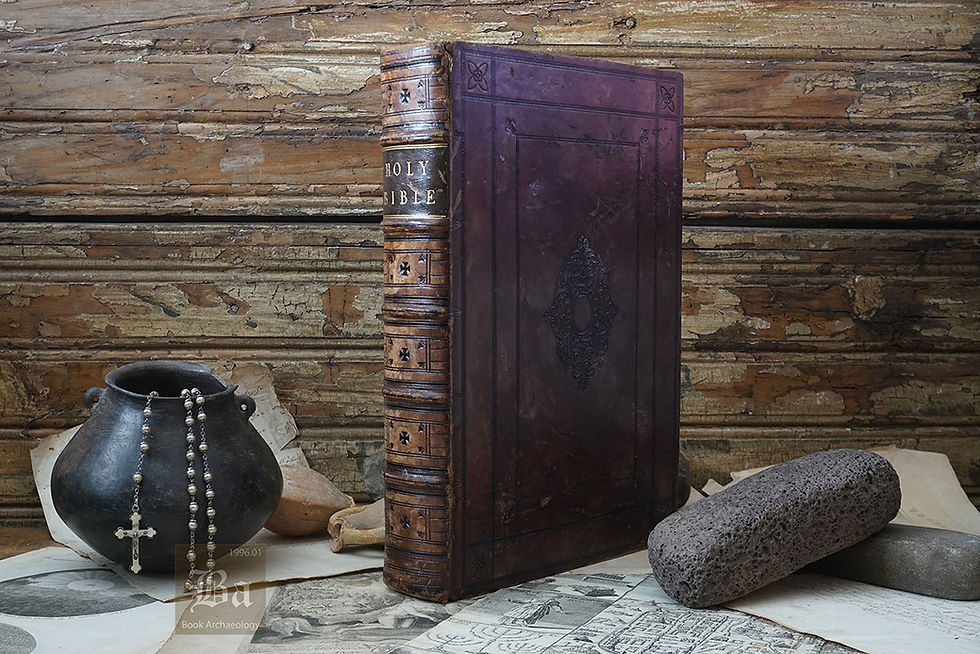
Binding features an imposing, museum-quality example of monumental 19th-century style English Revival binding. The volume is bound in a deep, rich chocolate-brown calfskin. The front and rear planes are intricately blind-tooled with a classic multi-frame paneled design, featuring geometric corner stamps and a prominent, deeply impressed central arabesque lozenge. The spine is a masterwork of Victorian era restoration, meticulously rebuilt across six deep, prominently raised bands. The individual spine compartments are elaborately decorated with hand-stamped Maltese crosses and delicate corner flourishes. A contrasting dark morocco leather lettering piece is fixed in the second compartment, sharply lettered in gold gilt: HOLY BIBLE. The leather exhibits an exceptional, deep luster with a highly desirable, untouched historic patina throughout. The heavy boards are structurally sound, however do show lite craking along upper and lower extremities. Overall, the binding shows honest shelf wear and subtle surface abrasions througout the exterior, consistent with centuries of handling. The joints, hinges, and headcaps have been professionally stabilized and consolidated, ensuring the massive volume opens can be handled and read with care. It serves as a monumental centrer-piece and remains structurally sound for display.
The Interior
The interior text block of this 1613 King James pulpit folio presents a fascinating blend of exceptional typographic preservation, typical historical wear, and highly skilled restoration. Printed on robust, handmade rag paper that has mellowed to a warm, uniform cream-to-tan tone, the Gothic "black letter" font remains remarkably sharp, deep, and legible throughout. A beautifully intact, liturgical calendar, showcasing flawless red-and-black rubrication within wide, uncropped margins. While the central gutter remains tight, flat, and securely bound, the volume displays a few localized structural vulnerabilities typical of heavily utilized pulpit Bibles. Specifically, a large jagged tear with partial paper loss impacts the lower-left border of the woodcut genealogy page, a curved tear with an old paper-tape repair encroaches into the text of the preliminary dedication leaf, and a clean horizontal tear forms a loose flap across a single column of an early text page. Most crucially for collectors, the volume has been thoughtfully completed with the general Old Testament Title, the New Testament Title, a single leaf in Matthew (Chapters 5–6), and the final leaf of Revelation all supplied in expert facsimile. These facsimiles are executed to an exceptionally high standard on period-style paper that beautifully replicates the weight, texture, and natural tone of the surrounding historic leaves, offering a seamless and highly presentable reading experience.
Detailed Report:
(Old Testament Title + New Testament Title + One leaf in Matthew (Ch. 5-6) + Last Leaf of Revelation Supplied in expert facsimile.)
Provenance & Collector Significance: (Distinguished Welsh Aristocratic Provenance) The front marbled endpaper features two highly desirable 19th-century ownership inserts belonging to William Thomas-Rowland Powell (1815–1878) of Nanteos Mansion, an iconic landed country estate in Ceredigion, Wales. The top insert is an engraved armorial bookplate displaying the Powell family coat of arms alongside their traditional Latin motto, "Inter hastas et hostes" (translating to "Between spears and enemies"). Directly below it is a rare, custom-printed book-lending slip bearing Powell's name, which politely requests that anyone borrowing the volume return it to the owner as soon as they have finished reading. These well-preserved plates firmly establish that this 1613 folio resided in the historic and extensive library of the prominent Powell family, adding an excellent layer of documented lineage and regional history to the Bible. The single most famous story surrounding the family library where this Bible once sat is its connection to the Holy Grail. The Legend is that during the Dissolution of the Monasteries under Henry VIII, seven monks fled the famous Strata Florida Abbey and took refuge at the property that would become the Nanteos estate. They carried with them a sacred, ancient wooden chalice believed to be the actual cup used by Jesus Christ at the Last Supper. (Reference Link: https://www.bbc.com/news/uk-wales-mid-wales-28324763) When the last monk died, they left the artifact, known globally as the Nanteos Cup, in the stewardship of the estate's masters. For centuries, the Powells kept the cup locked away safely in their vast library cupboard, the exact same room where your 1613 King James Bible was preserved. KNown for its healing powers all throughout the 19th and early 20th centuries, the Powell family would use the cup to help locals; they poured water from it to heal sick pilgrims who traveled from all over Europe. Desperate visitors over the generations actually bit physical chunks out of the wood in hopes of capturing its miraculous curing properties.
The Bible was owned by the "The Literary Elite" man who printed the bookplate in your Bible, William Thomas-Rowland Powell, whom was an influential Member of Parliament. However, his son, George Ernest John Powell (1842–1882), became the family's most notorious and historically interesting figure. George Powell was an avant-garde poet, a major patron of the arts, and an intimate close friend of the famous Victorian poet Algernon Charles Swinburne. Swinburne and other members of the Pre-Raphaelite art movement regularly stayed at Nanteos Mansion, spending long evenings carousing, writing, and studying the rare volumes in the Powell family library.
Price $9,950 | Purchase Page | See all SKU: 92008 (E)
By visiting our Purchase Page you can: Make Offers & Ask Questions
Please note: All offers will receive a response within 24hrs. If an offer is accepted, we will adjust the price on the site and respond with an email link to purchase.
Click View past sales to explore our Legacy Catalog, a comprehensive reference archive tracking the historical values, condition reports, and provenance of our previously sold rare Bibles and manuscript documents.
Thank you for being a Guardian of the Written Word


