Egyptian Terracotta Pseudostele or Pair Votive Statue, (Greco-Roman Period 332 B.C. - 642 C.E) | $2000.00
- Jan 20
- 5 min read
Crafted during the culturally vibrant Greco-Roman Period, this rare terracotta pair statue provides an intimate, physical look into the complex religious and funerary traditions of ancient Egypt under foreign rule. Dating between 332 BCE and 642 CE, this hand-molded votive plaque depicts a male and female figure seated side-by-side on a shared high-backed throne, their arms tenderly interlinked across their shoulders in a traditional gesture of eternal companionship. Rising behind their heads is an arched, stela-like backplate inscribed with hand-pressed hieroglyphic symbols, serving as an architectural framework to protect and identify the pair. Centuries of resting beneath the arid Egyptian soil have softened the definitions of the clay fabric, leaving behind a heavily textured, earthen patina woven with mineral encrustations. This object’s modern itinerary tracks directly through the contemporary antiquities market, having been held within a private estate collection in the state of New York. Surviving the collapse of classical antiquity to cross the Atlantic, this small domestic monument stands today as a tactile, beautifully patinated testament to ancient devotion and modern private preservation. Greco-Roman Period (c. 332 BCE – 642 CE) | Measures 3 ¾ inches tall (9.5 cm)
Price $2000.00 | Purchase Page | See all SKU: 31160
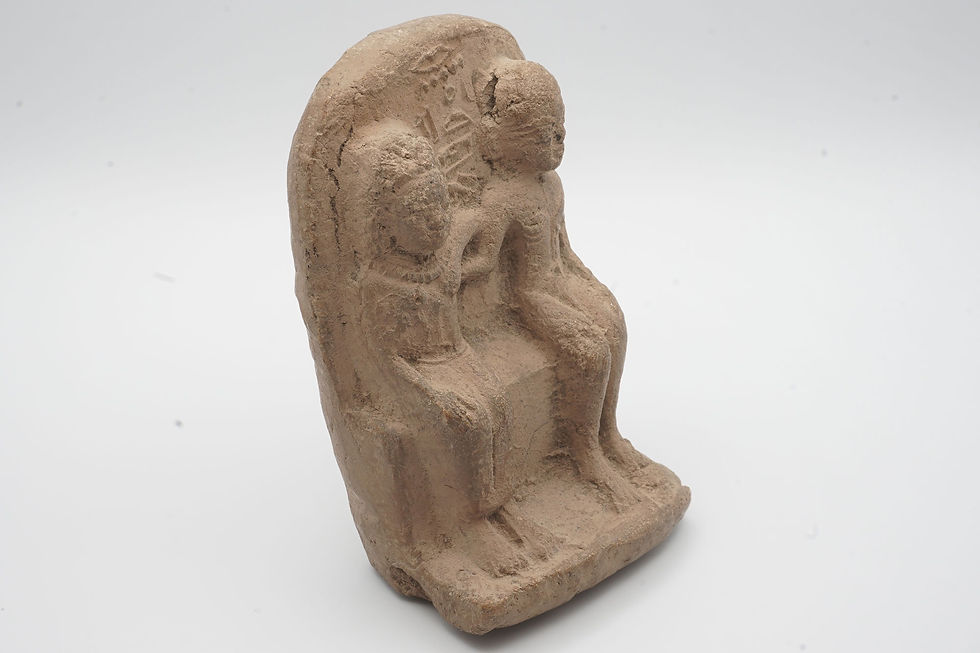
In the domestic and spiritual spheres of Greco-Roman Egypt, this type of small-scale terracotta figurine functioned as a deeply personal votive offering or a household protective idol rather than a grand public monument. Circulating at a price accessible to everyday provincial citizens, such "pair statues" were frequently placed within household shrines (lararia) to invoke blessings of fertility, marital harmony, and ancestral protection, or deposited inside tombs as funerary accompaniments. The traditional composition—showing a couple tightly unified on a bench beneath a protective stela architecture—replicates the monumental stone statuary of the Old and New Kingdoms, but rendered in a portable, affordable medium. Wrapped in organic linen or placed in small wall niches, these figures were integrated directly into family religious practices. It was typically only a household abandonment, a ritual deposition, or the final closing of a tomb chamber that consigned the object to the earth, shielding it across millennia.
Form & Stylistic Integrity
This piece showcases a compelling blend of traditional Egyptian iconography and classical Mediterranean styling, featuring a dual-figure layout framed by an arched backplate decorated with rudimentary hieroglyphs. The figures exhibit the distinct, softer anatomical proportions and rounded facial modeling introduced during the Ptolemaic and Roman eras, departing from the rigid, stylized musculature of earlier Dynastic art. The backplate bears low-relief glyphs, including a clear wedjat eye (Eye of Horus) at the apex to symbolize healing and protection, underscored by linear text registers. While the soft fabric shows expected smoothing and blunt features due to ancient mold wear, the essential lines preserve a high level of expressive symmetry. For the modern observer, the dense, uncleaned burial soil trapped within the deep recesses of the throne and figures does more than authenticate its age; it acts as a stunning visual patina that accentuates the relief carving, turning an ancient devotional plaque into a masterpiece of rustic visual depth.
Physical Place of Origin & Materials:
While objects of this style were utilized across the Nile Valley, its material composition points directly to the prolific coroplast (terracotta-making) workshops of Fayum or the Nile Delta regions. During the Greco-Roman Period, Egyptian artisans relied heavily on Nile silt clay—a rich, iron-dense alluvial soil that fires to a distinct reddish-brown or dark-buff color—or marly clays sourced from desert edges. Potters packed the wet clay into open-faced terracotta molds, smoothing the flat reverse side by hand before firing the piece in a standard low-temperature updraft kiln. On the back of the stela, the broad, flat, and somewhat uneven surface captures the exact manual pressure applied by an ancient artisan's fingers to press the clay deep into the mold matrices, freezing the human labor of an ancient Egyptian workshop into a permanent, solid form.

Condition Report & Preservation Status:
This ancient terracotta statue is presented in an excellent, stable excavated condition that beautifully documents its long passage through time. The ceramic body is remarkably complete, retaining its full-profile architectural structure from the flat rectangular base up to the rounded top of the stela backplate. The two seated figures remain entirely intact and securely joined to the bench, showing only expected, historic micro-abrasions and minor smoothing to the facial features and hair from ancient handling and soil movement. The reverse side features a massive, vintage paper label residue with an aged, red-bordered outline, denoting a long history of past cataloging and storage. The entire exterior is blanketed in a highly authentic, uncleaned layer of variegated burial soil and calcified mineral deposits, which remains left undisturbed to protect the delicate relief work and grant the piece superb curatorial display character.
Provenance:
Acquired from Hamedian Gallery, Jerusalem, Old City Israel
This artifact carries a clean, uncomplicated modern provenance, having been sourced directly from a private collector based in the state of New York. The reverse side of the stela features a significant physical anchor to its past collection life: a large, vintage paper label backing with a faded red-bordered edge, a classic indicator of late 19th or early-to-mid 20th-century private estate cataloging systems. While the specific early 20th-century museum or gallery ledger numbers originally penned onto the center of the paper have worn away over time, the physical presence of this unremoved, heavily aged label residue confirms a long timeline of documented western ownership. This established presence within a New York collection anchors the object safely outside of modern cultural heritage restrictions.
Price $2000.00 | Purchase Page | See all SKU: 31160
By visiting our Purchase Page you can: Make Offers & Ask Questions
Please note: All offers will receive a response within 24hrs. If an offer is accepted, we will adjust the price on the site and respond with an email link to purchase.
Click View past sales to explore our Legacy Catalog, a comprehensive reference archive tracking the historical values, condition reports, and provenance of our previously sold Rare Bibles and Antiquities.
Thank you for being a Guardian of the Written Word
Epigraphic Breakdown & Translation
Top Register (Above the heads):
The Signs: A stylized mouth sign (𓂋 - r) above a horizontal wavy line representing water (𓈗 / 𓈝 - n).
The Meaning: This forms the core of the ancient Egyptian word "Ren" (𓂋𓈗 - rn), which translates directly to "Name." In a funerary or votive context, invoking the "name" was a magical act to ensure the eternal remembrance, survival, and identity of the deceased couple in the afterlife.
Middle Register (Between the faces):
The Signs: A broad, semi-circular loaf of bread sign (𓏏 - t) stacked over a stylized placemat or altar sign (𓊵 - htp).
The Meaning: This forms the highly recognizable "Di-Hetep" or "Hetep" formula, which translates to "An Offering Given" or "Peace / Satisfaction." It is the standard opening phrase used on nearly all Egyptian funerary stelae to invoke a perpetual supply of food, drink, and divine favor for the spirits.
Lower Register (Between the torsos):
The Signs: A linear geometric glyph resembling a house floor plan or shrine boundary (𓉐 - pr), underscored by a final horizontal determinative stroke.
The Meaning: This represents "Per" (𓉐 - pr), meaning "House," "Estate," or "To Go Forth." When paired with the offering signs above it, it refers to the ritual act of Pr-Kheru ("Going forth of the voice"), magically manifesting spiritual sustenance (bread, beer, and oxen) straight from the divine realm into the house of the deceased.
Taken together, the text reads as a compressed, shorthand blessing for the couple:"May the name be remembered; a peaceful offering goes forth [for them]."
During the Greco-Roman Period, local artisans frequently condensed these massive, traditional temple prayers into a few essential, highly stylized glyphs. This allowed everyday buyers to secure the full magical protection of an ancient Egyptian funerary prayer on a small, affordable household monument.


