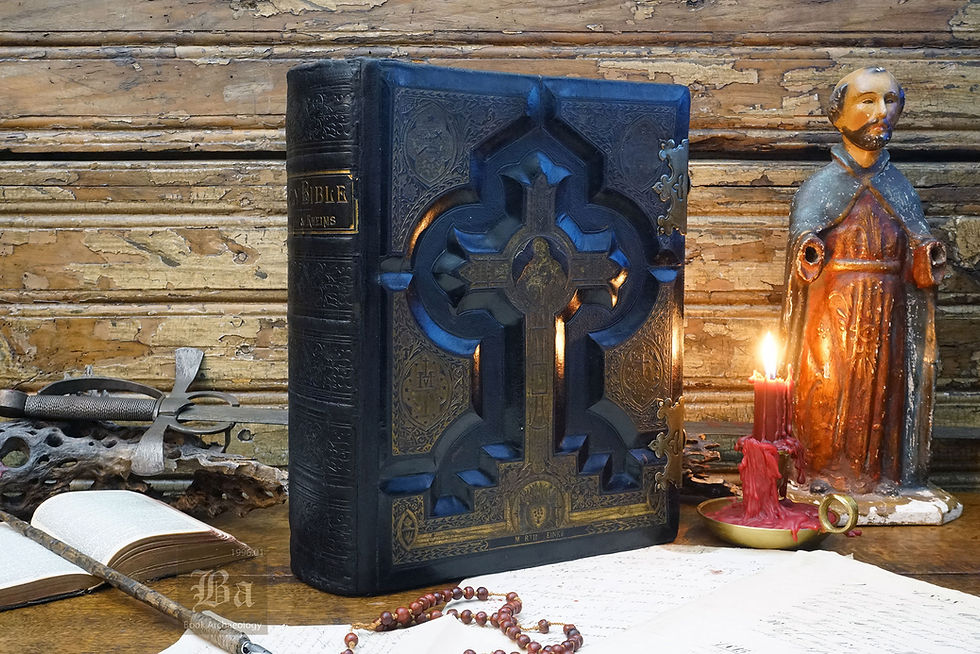
1584 Bishops Bible Folio (Last Quarto Edition) | Sold for $2,900
Updated: Sep 1
Historical Importance of the 1584 Bishops' Bible
The 1584 Bishops’ Bible represents a critical transitional period in English history, serving as the official ecclesiastical bridge between the Great Bible of Henry VIII and the later King James Version. Commissioned by the Church of England to counter the popular but "radical" marginal notes of the Geneva Bible, this edition was the version read aloud from church pulpits during the height of Queen Elizabeth I’s reign. While it struggled to compete with the Geneva Bible, its historical weight is immense, the 1584 printing was the final quarto edition of the series, and the overall text of the Bishops' Bible was the primary model that King James’s translators were legally required to follow in 1611, ensuring its phrasing and rhythm survived into the most famous English Bible of all time.
Sold for $2,900 | ← Return to Past Sales | Active Sales Page →

Historical Context of the Bishops' Bible
Originally commissioned by Archbishop Matthew Parker in 1568, this translation was designed to replace the Great Bible in pulpits and, more importantly, to provide a conservative alternative to the wildly popular Geneva Bible, whose Calvinist marginal notes were viewed as a threat to royal and episcopal authority. As the final quarto edition ever printed, the 1584 Bible represents the closing chapter of this version’s attempt to capture the hearts of the English laity before it was ultimately superseded.
Queen Elizabeth I's Reign & Role in the Printing of this Bible
Queen Elizabeth I reigned from 1558 to 1603, a period marked by significant political and religious developments in England. Upon ascending the throne, Elizabeth sought to establish a moderate Protestant church that would be acceptable to both Catholics and Protestants. The Act of Supremacy (1559) reinstated the monarch as the head of the Church of England, while the Act of Uniformity (1559) established the Book of Common Prayer. Despite her attempts at moderation, Elizabeth's reign saw continued tension between Catholics and Protestants. Catholics faced persecution, particularly after the Papal Bull of excommunication in 1570, which declared Elizabeth illegitimate and called for her overthrow.
Despite her adversaries best efforts, this period is known for its cultural achievements, including the works of Shakespeare and the flourishing of the arts. Elizabeth's reign also marked the beginning of English exploration and colonial expansion, with figures like Sir Francis Drake and Sir Walter Raleigh playing significant roles.
Conflicts Between Protestants and Catholics
The conflicts between Protestants and Catholics during Elizabeth's reign were deeply rooted in the broader European context of the Reformation. The Spanish Armada's attempted invasion in 1588 was partly motivated by the desire to restore Catholicism in England. While within England, Puritans sought further reforms of the Church of England, leading to tensions with the established church. Elizabeth's attempts to maintain a middle ground often resulted in dissatisfaction on both sides. With the execution of Mary, Queen of Scots, in 1587, playing a pivotal role in the heighten tensions as many viewed Mary, Queen of Scots as the legitimate heir to the English throne.
The Legacy behind the 1584 Bible
The legacy of the 1584 Bishops’ Bible lies in its role as the final quarto attempt to solidify a uniform, Anglican identity within the English home before the version was largely relegated to the pulpit. While it never achieved the widespread domestic success of its rivals, its enduring impact is found in its DNA: it served as the mandatory base text for the 1611 King James Version. By preserving specific ecclesiastical terms—such as "church" instead of "congregation" and "charity" instead of "love", the 1584 edition ensured that the formal, majestic tone of the Elizabethan church would be immortalized in the most influential English translation of all time.
Distinguishing Mark: No general title page is known to exist for the 1584 edition; it is typically identified by its New Testament title page or colophon
Condition Details: Bible begins at (Preliminaries) B6 in the Collects and continues until its end at C4, after-which it includes The Whole Scripture of the Bible, followed by A Prayer, No General Title Page Present, and then begins the Old Testament at Gen Ch 1. w/ text loss at the lower right edge of the leaf (see photo). Pages are a bit rough with heavy chipping along outer edge until Gen. Ch 23. after-which the leaves appear quite nice. The leaves are tightly cropped along the top and fore edge, affecting page titles and marginalia in some areas. There is a small closed tear at G3 and small burn whole at G6. The Bible continues quite nicely and ends at the close of Revelation, w/ Apocrypha Title, NT Title and Whole Book of Psalmes Title intact. There is staining, some dog-earing and some repaired leaves where text-loss occurs (see photos).The Whole Booke of Psalmes appears quite complete through Psalme 150 (CL) and continues w/ The Lord's Prayer, The VII Articles of the Christian Faith, A Lamentation, A Thanksgiving and end on A Prayer against the Divel & His Manifold Temptations.
Sold for $2,900 | ← Return to Past Sales | Active Sales Page →
By visiting our Purchase Page you can: Make Offers & Ask Questions
Please note: All offers will receive a response with 24hrs. If an offer is accepted we will adjust the price on the site and respond with an email link to purchase. Thank you for being a Guardian of the Written Word