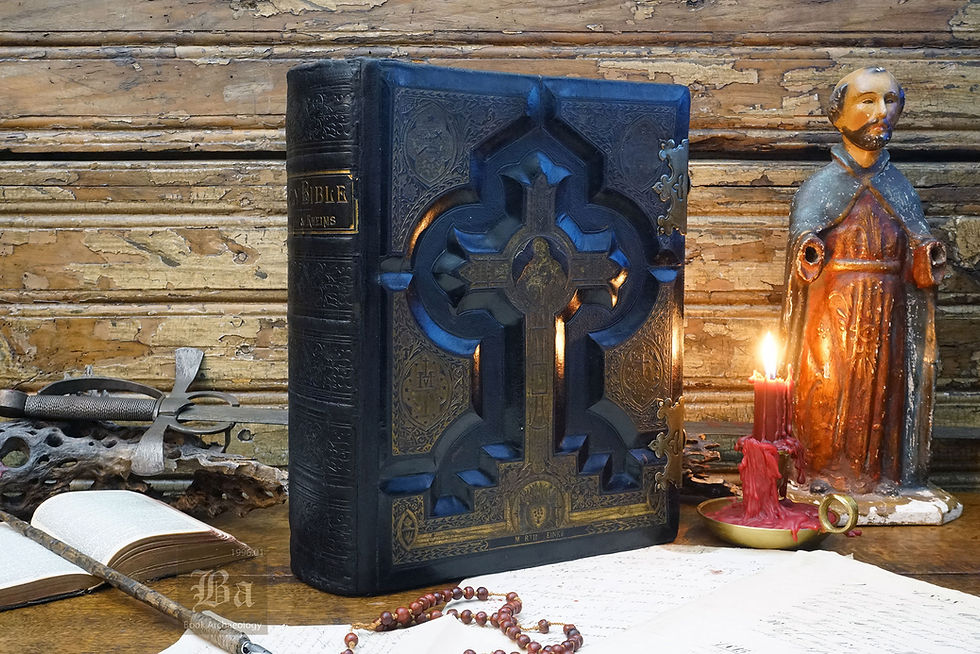
1886 Victorian Family Holy Bible | H.D. Burroughs | Parallel-Column Edition | SOLD
- Jan 2
- 3 min read
Updated: Jul 24
This 1886 Victorian Family Holy Bible by H.D. Burroughs, is a beautiful artifact from the history of religious publishing. This edition is not just a Bible; it is a richly illustrated folio that combines faith, art, and family heritage in a single volume. With well over 1000 detailed illustrations, a heavy embossed leather cover, and additional features like a Bible Concordance a Complete Book of Psalms and Chronological Chart of Biblical Events, this Bible offers more than scripture—it offers a window into the spiritual and cultural life of early American families.

PARALLEL-COLUMN EDITION.
THE
HOLY BIBLE
CONTAINING
THE AUTHORIZED AND REVISED VERSIONS
OF THE
OLD AND NEW TESTAMENTS.
ARRANGED IN
PARALLEL COLUMNS
THE TEXT CONFORMABLE TO THAT OF THE UNIVERSITIES OF OXFORD AND CAMBRIDGE.
WITH
A COMPLETE CONCORDANCE AND THE PSALMS OF DAVID IN METRE.
COPIOUS MARGINAL REFERENCES, CHRONOLOGICAL TABLES, AND MANY IMPORTANT AND USEFUL AIDS TO THE STUDY OF THE HOLY SCRIPTURES, ALL WRITTEN TO INCREASE THE INTEREST IN AND SIMPLIFY THE STUDY OF THE WORD OF GOD.
H. D. BURROUGHS.
RAVENNA,
OHIO.
About this Particular Bible
This Bible is considered one of the larger and more comprehensive Bibles of the Victorian Era. It Features The Old & New Testament arranged in parallel columns, featuring the King James Version on the left column and the 1881 revised translation in the right column.
The Exterior
The Bible has undergone a sympathetic restoration that has preserved its historical character and charm. It features a newly re-backed spine and reinforced inner hinges, enhancing its durability beyond its original condition. The original leather has been treated and protected to prevent flaking and further deterioration, ensuring its preservation for many years, potentially extending its lifespan by another 100 to 200 years with proper care.
The Interior
This Bible has it's original pastedowns and one of it's original fly leaves (front). The initial sections, up to the History of the Books of the Holy Bible (as shown in a photograph), exhibit wear on the outer edges, with noticeable chipping on the fore-edge of the pages. The preliminary Presentation Leaf is blank, along with the Matrimonial Leaf and Genealogy Leaves also being blank. It is crucial to understand that these are not new Bibles; they are antiquarian books that should be treated accordingly, in this case, a 140 year-old Bible.
We provide detailed photographs to allow you to assess the book's condition and aesthetic appeal. Many, if not all, of the early books and Bibles we offer will show signs of aging, whether it's foxing on the pages, dog-eared or chipped corners, inscriptions from previous owners, or staining from years of use.
Why This Bible Still Matters Today
In a time when digital media dominates, this 1886 Victorian Family Holy Bible reminds us of the power of physical books to connect us with history, faith, and family. Its detailed illustrations invite readers to slow down and reflect. It encourages us to appreciate the craftsmanship of the past and to consider how we preserve our own stories for future generations.
The Role of Book Archaeology in Preserving This Heritage
At Book Archaeology, these Bibles are not only religious texts but also historical artifacts that reveal much about the cultural and spiritual lives of the past. As Guardians of the Written Word, we understand that preserving such volumes requires careful attention to their physical condition and historical context. Book Archaeology helps keep alive the stories and traditions embedded in these sacred pages.

Sold | Purchase Page | See all